Dollar Holds Firm as Equities Slide on Iran Tensions, Rate Fears
European stocks and US futures fell Friday as Middle East conflict and sticky yields offset softer inflation data, keeping traders on edge.
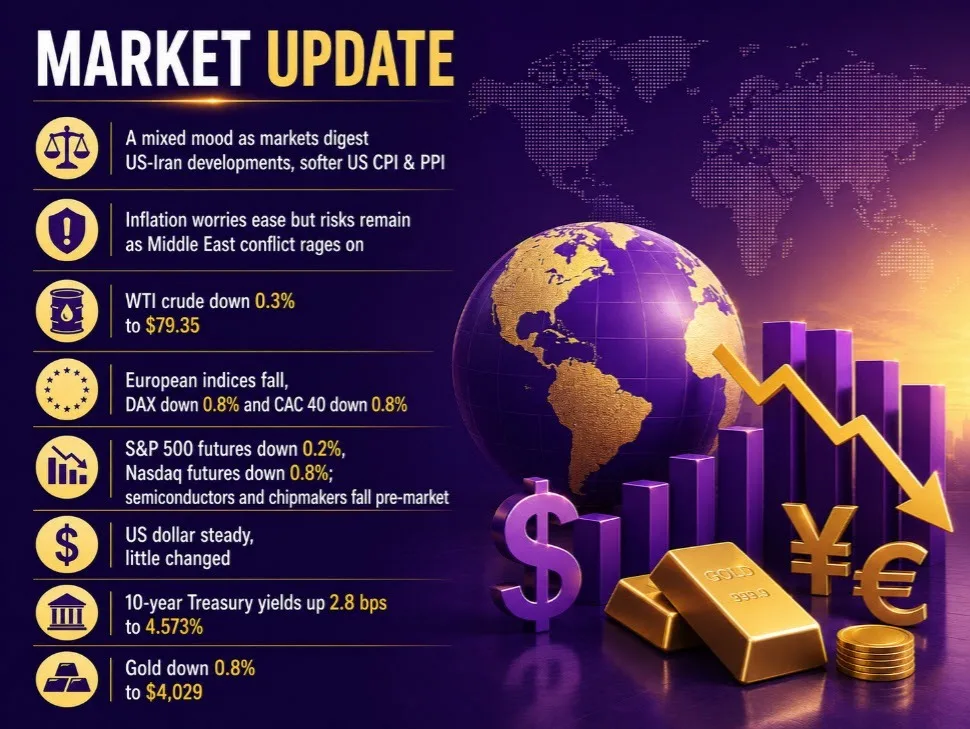
Global markets entered the weekend on a cautious footing Friday, with European equities and US futures sliding lower as geopolitical tensions in the Middle East overshadowed encouraging inflation readings earlier in the week. The DAX and CAC 40 each dropped 0.8%, while S&P 500 futures fell 0.2% and Nasdaq futures shed 0.8%, dragged down in part by another rough session for semiconductor and chipmaker stocks.
Iran's army issued a stark warning that ongoing US strikes could cause the conflict to "spread to new areas," rattling investor sentiment and keeping oil prices elevated. WTI crude dipped just 0.3% to $79.35, holding near the $80 level for the week. The geopolitical backdrop is also pushing bond yields higher despite softer US CPI and PPI data — 10-year Treasury yields climbed 2.8 basis points to 4.573%, while 30-year yields remained elevated at 5.11%.
Read more Tokenized Stocks Market Cap Hits Record $2.3 Billion →
The dollar stayed broadly steady, with higher yields limiting downside for the greenback. EUR/USD was flat at 1.1465 and USD/JPY unchanged at 162.15, while GBP/USD retreated 0.3% to 1.3500 after surging more than 1% the prior session. The Canadian dollar led G10 FX gains on the day; sterling lagged. Gold continued a week-long pullback, falling 0.8% to $4,029, and Bitcoin slipped 1.1% to $64,219.
On the data front, the UK economy eked out 0.1% monthly GDP growth in May, in line with expectations and driven by a rebound in services. The eurozone's trade deficit widened further in May to its largest shortfall since January 2023, adding another layer of concern for euro-area policymakers. Swiss National Bank minutes showed inflation pressures "virtually unchanged" with monetary conditions deemed appropriate, while Bank of England's Breeden said the central bank was in a "good place" to monitor evolving conditions.
With the European session closed, attention turns to US retail sales data, though analysts note that the US-Iran confrontation and its potential implications for inflation are fast becoming the dominant macro theme heading into the second half of the year. Continue reading at Forexlive.